
|
![]()
"LaCam" measurement principle
The LACAM profile-measuring system has been developed for non-contact measurement of refractory linings in metallurgical reaction and transport vessels. In contrast to the previous device, the RTF 03 HS, LACAM enables much shorter duration of measurements and by this an improvement of the steel production process. This is achieved by rapid scanning of the object via a pulsed laser beam which is deflected by a rotating mirror system. Thus, a three dimensional frame of the vessel’s inner surface with typically 200,000 range points is created within 20 seconds. By comparison with a previous reference measurement, the residual brick thickness of the refractory is evaluated by the built-in industrial PC. The graphical user-interface permits detailed investigations of the wear development as well as automatically printed reports of the measurements.
The scanning unit
The control and operator unit
An IBM-compatible industrial-type computer collects, processes and evaluates the measured values. The unit offers menu-driven operation during measurement, processing and result presentation. Indication of operator errors and plausibility checks make it easy and safe to handle. The computer has a sturdy housing against dust and splash water. A flat screen with TFT active technology provides excellent colour graphics. The operation can be carried out as well by touchscreen as by a film-covered keyboard. Thus the unit is suited for the use under extreme operating conditions.
The mobile unit
It includes the scanning system and the control and operator unit described above. Also included is the instrument’s power supply. The unit can be operate with line voltage or storage battery. The dry battery permits line-independent operation for a prolonged period of time, e. g. for a complete converter scanning operation. The storage battery also ensures uninterrupted continuation of work in case of power failure thus avoiding loss of data or time-consuming repetition of the measurement. The frame of the mobile unit also includes the heat shield, which has to be moved up for operation. When moved down, the heat shield serves also as a protection for the scanning system and the display unit (normal transport position). This high reflective heat shield gives optimum protection to the operator and the instrument components. Thus, the unit can be positioned very close to the measured object and even regions normally hidden from view become accessible for scanning. Additional external cooling with air or water is not necessary. The compact mobile unit with sturdy transport wheels can easily be transported by a single person.
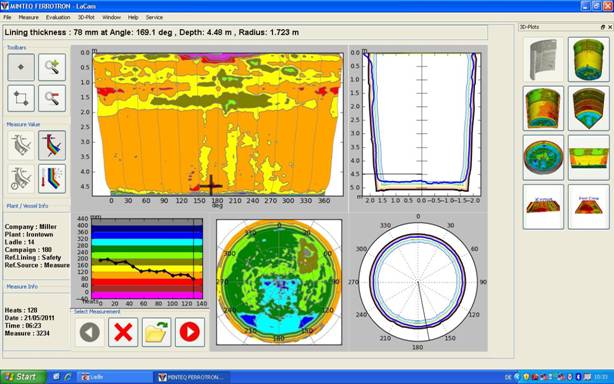
Evaluation and visualization

Color represented brick thichness
The standard software package is based on Windows NT (firmware).
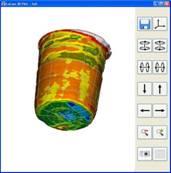
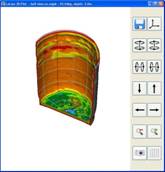
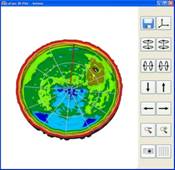
Results can be represented in various forms: In addition to the usual tables of residual brick thickness, graphical representations in the form of horizontal and vertical section views are also available for various applications. The contour line diagrams are especially useful as they permit chronological long-time observation of converters and document the development of weak points. The evaluation of the measurements can be performed on site by the built in computer.
Additional evaluations can be carried out by an external computer: "Laserwin" based on Windows NT or Windows 95 / 98.
Available evaluations:
|
For the evaluation of the tilting angle of the converter an inclinometer is used.